Herculaneum Entry Ticket with Audio Guide
General information about the ticket
Herculaneum was a prosperous Roman town on the Bay of Naples until the eruption of Mount Vesuvius in 79 AD buried it under a pyroclastic flow reaching temperatures above 400 degrees Celsius. Unlike the ash and pumice that fell on nearby Pompeii, this scorching material carbonized wood and other organic material instead of destroying it, leaving multi-story houses, furniture and decorative details in exceptional condition.
Ticket overview:
🏛️ Entry to the excavated archaeological park of Herculaneum.
🖼️ Multi-story Roman houses with original mosaics, frescoes and carbonized wood.
🎧 Downloadable audio guide app included (English, French, Italian and Spanish).
📅 Whole-day access with no fixed entry time slot.
🌋 Set in Ercolano, at the foot of Mount Vesuvius near Naples.
What's included?
Included
- Entry to the Herculaneum archaeological park
- Access to the excavated houses, shops and public buildings of the ancient town
- Downloadable audio guide app for the visit
Not Included
- Guided tour
- Cancellation option
- Mobile device for audio guide
Important information
- Bring valid photo identification if the reduced-price ticket applies.
- The booking is delivered as a smartphone voucher; present it at the ticket office to enter the park, then follow the link included in the voucher to download the digital audio guide app to a personal device.
Cancellation policy
The ticket is non-refundable. Once purchased, the date and time cannot be changed.
Location of Herculaneum
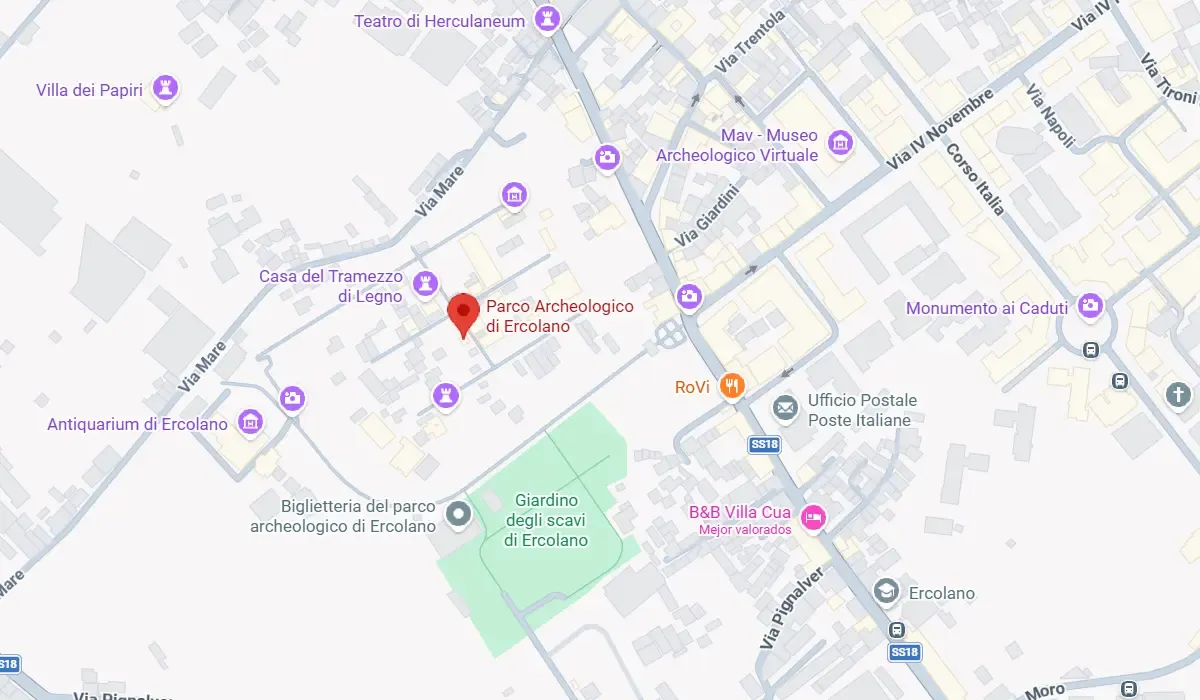
Address: Corso Resina 187, 80056 Ercolano (Napoli), Italy.
Closest landmark: Mount Vesuvius, whose slopes rise directly above the site, with the nearest train station, Ercolano Scavi, about a six-minute walk from the park entrance.
Herculaneum lies in the modern town of Ercolano, on the Bay of Naples between Naples and Sorrento. The ancient town sits in a deep excavation pit well below current street level, its multi-story houses still capped in places by their original upper floors, a contrast with the more widely known and more exposed ruins of nearby Pompeii.